My first time at a teaching meeting
By Matheus Januario
In April 2026, I was deeply honored and grateful to have our teaching software recognized with the Society for the Study of Evolution’s T. H. Huxley Award for Evolution Education Resources. The recognition and kind words from so many colleagues have been incredibly meaningful. However, one of the most rewarding aspects of receiving this award was the opportunity to attend a related conference of my choice, generously offered by the Society, and present our work. I chose to develop and lead a workshop showcasing our educational tool at the National Association of Biology Teacher’s (NABT) Professional Development Conference—and so off I went to Dallas, Texas.
As a postdoctoral researcher, most of my previous conference experiences had been centered around research meetings, so I had relatively little idea of what to expect from NABT. The depth of the discussions, the different perspectives, and the many practical ideas I encountered throughout the conference have greatly enriched my participation—such a rewarding experience that I felt compelled to write this post in the hope that it might encourage others to give NABT a try, particularly those who, like me, primarily come from a research-oriented background.
I lead a workshop introducing our teaching tool, evolved. Since this was my first time organizing a workshop specifically around teaching, I opted for a relatively simple format: introducing and contextualizing our software, then inviting participants to give it a try, and posteriorly discuss its potential applications and limitations in the context of their classrooms. We have been using evolved at the University of Michigan for the past four years, but the conference offered a wonderful opportunity to broaden my perspective and learn how teachers from different educational settings, including universities and high schools, might find it useful (or clunky) in their own classrooms. I returned from Dallas with multiple notes and many ideas for improving our package. Some suggestions were relatively straightforward to address. For example, one professor suggested developing a tutorial explaining how teachers could prepare their own datasets—such as collections of GenBank sequences they have personally selected—to make them compatible with evolved. This is an excellent suggestion, and one we will be working on ASAP. Other discussions focused on the platforms through which the package could be made more accessible to educators and students. I was particularly surprised to learn that many high school students cannot install R on their school computers, which are often Chromebooks or other restricted devices. To me, this emphasizes that depositing software in open source archives like CRAN is nothing but a step towards a truly accessible educational software. Addressing this will take more work, but the timing could hardly be better: part of my upcoming postdoctoral work at the University of Michigan in 2027 will involve further developing and expanding evolved. Keep an eye on my website for these and other updates on our software.
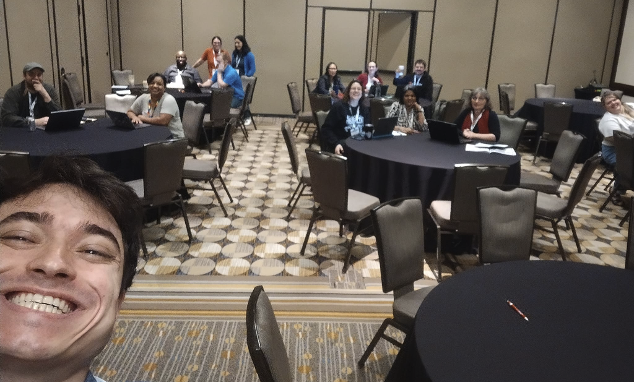
Once my workshop was over, I was free to roam around the meeting, get to know more educators from across the US, and listen to the many interesting talks at the NABT. I attended presentations ranging from student-made online tools for protein visualization to entirely hands-on, analogical activities designed to help students grasp relatively abstract concepts, such as geological timescales and evolutionary divergence—the later also standing out to me as a broader discussion on how educator cognitive diversity can enhance our understanding of students’ perspectives, ultimately helping to develop more effective lessons. Other highlights included thoughtful discussions on strategies to help students feel they matter—even in large courses with more than 200 students. These were just a few examples of the many insightful presentations and conversations that made the meeting such a rewarding experience to me.
Another particularly pleasant routine at the conference were the daily plenary talks and events designed for the entire conference to attend. The program brought together speakers from a wide range of backgrounds, from Nobel laureate Phillip Sharp to the beloved educational science communicators the Amoeba Sisters. These sessions brought the entire conference community together and also created a wonderful sense of shared enthusiasm for science and education. Among these memorable events, I must also mention the screening of PBS’s The Battle to Breathe, a documentary highlighting extraordinary scientific advances in the understanding and treatment of cystic fibrosis. The screening was followed by a live interview with Dr. Jennifer L. Taylor, one of the researchers featured in the documentary. It was truly moving to share this experience with hundreds of fellow educators, collectively re-elaborating our mission as science educators through both the film and the thoughtful conversations with all these renowned speakers.
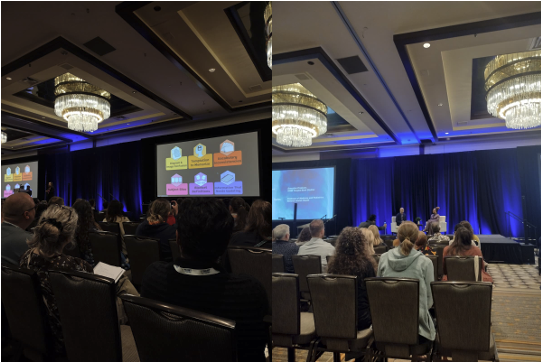
One topic I was particularly eager to hear about at NABT was artificial intelligence—the elephant in the room. I was not disappointed. Although strong skepticism toward AI was evident in several presentations and informal conversations, I was pleasantly surprised by the number of educators sharing their experiences with embracing these tools and exploring new ways of incorporating them into the classroom. Of course, not all these approaches are suitable for every educational context, particularly given that many institutions currently have strict policies governing AI use. I am also still unsure whether I will have the opportunity to apply some of these strategies in the near future, as I am not currently scheduled to teach a course. Nevertheless, I found it extremely valuable to learn how educators at different levels are teaching students to use AI responsibly, establishing appropriate class boundaries, and rethinking aspects of their courses and assessments in light of these new tools. I will certainly continue to experiment with some of these ideas whenever opportunities arise, even if it is outside a formal teaching environment.
From seemingly simple activities such as calculating the time elapsed between geological periods, to exploring AI-powered student projects, I left NABT with a better understanding for the adaptability, creativity, and thoughtfulness our fellow educators bring to their classrooms. I am deeply grateful to the Society for the Study of Evolution for making this experience possible to me. And to my fellow scientists reading this: if you ever have the opportunity, I truly encourage you to attend an NABT meeting. You may come from a research-oriented background, as I did, but I am confident you will leave with new ideas for our role as science educators. The next meeting will take place in Minneapolis (MN), and I hope you will have the opportunity to experience it firsthand.