Everything, everywhere, all at once
By Matheus Januario
I started my older blogpost by saying:
“Across vast spans of time, life’s imperfect replication has generated an extraordinary diversity of forms. Each evolutionary innovation expanded the range of possible ecological interactions, producing increasingly complex biological systems. Through this cumulative process, life has repeatedly confronted and reorganized the material and energetic constraints of organic matter.”
What did I mean by this? A whole lot of stuff! But I found a pretty cool way to give you an idea. The internet has a funny way of leading you down unexpected paths, and one of mine led me to this interesting paper: “All objects and some questions” by Charles H. Lineweaver and Vihan M. Patel. The authors set themselves quite a task: to provide, in their own words, “an overview of the thermal history of the Universe.”
You should definitely give it a read, but here’s the basic idea: they place virtually everything in the Universe on a single diagram, plotting size on the x-axis and mass on the y-axis, both on logarithmic scales. The result is a map of the physical world, where lines represent power laws and reveal relationships between objects across an astonishing range of scales.
Their central point is that the things familiar to our everyday experience occupy a relatively small triangular region of this space. The reason? Physics imposes hard constraints on what can exist in the first place, limiting which combinations of size and mass are physically possible.
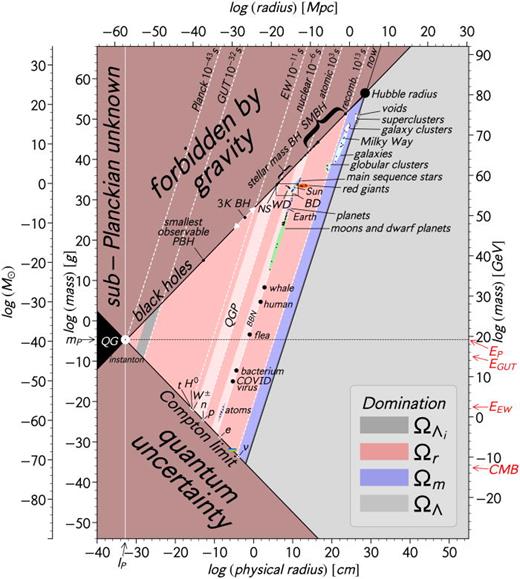
Now, here’s what I really want to draw your attention to: look at how much space life spans in this diagram! Even if we’re conservative and draw an ellipse encompassing all living organisms from whales to bacteria, it covers an astonishing range of sizes and masses. Life’s area in this diagram is enormous, spanning multiple orders of magnitude. Sure, life doesn’t extend across an equally impressive range of physical sizes. There’s a good reason for that: organisms need to maintain some degree of internal coordination, and cells need to communicate, exchange materials, and work together. But when it comes to mass, oh boy, do we cover some ground!
Now compare life’s span with the ellipse you’d draw around what we usually think of as outer space, from Earth-sized objects all the way to the main sequence stars and a little beyond. In this diagram, life spans more orders of magnitude in area than probably most of the cosmos we usually think about in our daily lives. Let that sink in for a moment.
And here’s what makes this truly remarkable to me: life doesn’t just exist across this range. It changes itself. It grows, reproduces, competes, cooperates, flies, swims, hunts, photosynthesizes, decomposes, builds reefs, transforms landscapes, cycles nutrients, and reshapes the atmosphere. Tiny archaea regulate the chemistry of deep sea ecosystems, while trees capture carbon and whales transport nutrients across oceans. Fungi connect trees through vast underground networks, and microbes thrive in thermal vents that would kill most other living things. Life operates across an extraordinary range of scales, with countless ways of interacting with the world.
And, as far as we know, all this diversity descends from a common ancestor. Every blue whale, E. coli, mushroom, oak tree, and human belongs to one sprawling evolutionary family, connected through billions of years of change, and spanning a mind-blowing range of scales.
That’s what I wanted you to appreciate in the figure above: not just how diverse life is, but how much of the physical world it encompasses, how many different ways it has found to persist, and how profoundly it has transformed our planet. You and your living cousins are part of something extraordinary.
And we haven’t even included viruses in any of this. I’ll leave that for another day.
References:
Lineweaver, C. H., & Patel, V. M. (2023). All objects and some questions. American Journal of Physics, 91(10), 819-825.